|
|
|
|
|
|
|
|
|
Conus tjilonganensis (Martin, 1906)
Descrizione:
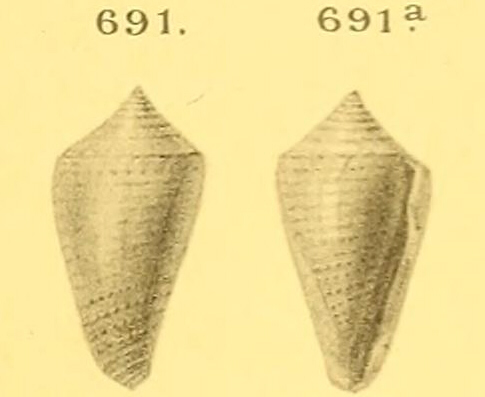
Ziemlich schlanke Schalen mit kurz-kegelförmigem, im Profile kaum ausgeschweiftem Gewinde, dessen Embryonalende nicht unversehrt erhalten ist, aber anscheinend aus zwei Umgängen bestand; ausserdem kommen bis zu acht jüngere Windungen vor, deren älteste einen schwachhervortretenden, mit undeutlichen Knoten versehenen und an der vorderen Naht gelegenen Kiel zeigen. Sonst sind die Umgänge mit scharf eingeschnittenen Spiralfurchen versehen, welche von wohl entwickelten, schwach sichelförmigen Zuwachslinien geschnitten werden. Die Schlusswindung besitzt einen scharfen Winkel; ihre Profillinie ist vor dem Letzteren gewölbt und nahe der Stirn etwas ausgeschweift. Sie ist mit entfernt stehenden Spiralleisten bedeckt, welche vorn und unmittelbar vor dem Winkel feine Knoten tragen; u. d. L. bemerkt man in den Zwischenräumen eine Anzahl zarterer Leisten, von denen die mittlere noch wieder kräftiger hervortritt als die übrigen. Die Zuwachslinien fallen hier wenig ins Auge; die Spindel ist nicht gedreht; die Länge der Schale erreicht 25 mm (2).
Fossil ist keine eng verwandte Form bekannt; unter den recenten Arten steht aber der auch an der Küste von Java lebende C. boeticus Reeve (pl. 42, spec. 226) der Versteinerung sehr nahe. Indessen unterscheidet sich die Letztere durch einen etwas schärferen Winkel und besonders durch ein verhältnissmässig höheres Gewinde. Auch C. pauperculus Sow. von Japan (Reeve, pl. 20,spec. 108) ist verwandt, aber schlanker und ohne Spiralskulptur auf dem hinteren Abschnitte der Schlusswindung; auch ist bei ihm das Gewinde stumpfer und der Spiralwinkel weniger scharf als bei der Versteinerung (2).
Zwei Exemplare von Tjadasngampar am Tji Longan und ein drittes aus der Gegend von Njaliendung (2).
Fairly slender shells with a short conical thread, hardly flared in profile, the embryonic end of which is not intact, but apparently consisted of two whorls; there are also up to eight younger whorls, the oldest one weak showing a prominent keel with indistinct knots and located at the anterior suture. Otherwise the whorls are provided with sharply incised spiral sulci, which are intersected by well-developed, faintly crescent growth lines. The final whorl has a sharp angle; their profile line is arched in front of the latter and somewhat flared near the forehead. It is covered with distant spiral ridges, bearing fine knots in front and just before the angle; etc. L. one notices in the interstices a number of more delicate ridges, of which the middle one stands out even more strongly than the others. The growth lines are not very noticeable here; the spindle is not rotated; the length of the shell reaches 25 mm (2).
No closely related form is known to fossil; among the recent species, however, C. boeticus Reeve (pl. 42, spec. 226), which also lives on the coast of Java, is very close to fossilization. The latter, however, is distinguished by a somewhat sharper angle and especially by a comparatively higher thread. Also C. pauperculus Sow. from Japan (Reeve, pl. 20,spec. 108) is related, but more slender and without spiral sculpture on the posterior portion of the terminal whorl; also the thread is duller and the spiral angle less sharp than in the fossil (2).
Two specimens from Tjadasngampar on the Tji Longan and a third from the Njalieending area (2).
|
|
|
|
|
|
|
|
|
|
|
|
|
|
|
|
|
|
|
|
|
|
|
|
|
|
|
|
|
|
|
|
|
|
|
|
|
|
|